I hope you enjoyed the video? Don’t forget to hit like and Follow for more Fun DIY Experiments!! 👍 MORE videos are coming soon!
Author Archives: Christian Akpota
Welcome, I share Daily Science Facts and Trivia that will keep you amaze everyday! Pls Follow for more! 🙏🙏
Hawaii Moves 7.5cm closer to Alaska Every Year
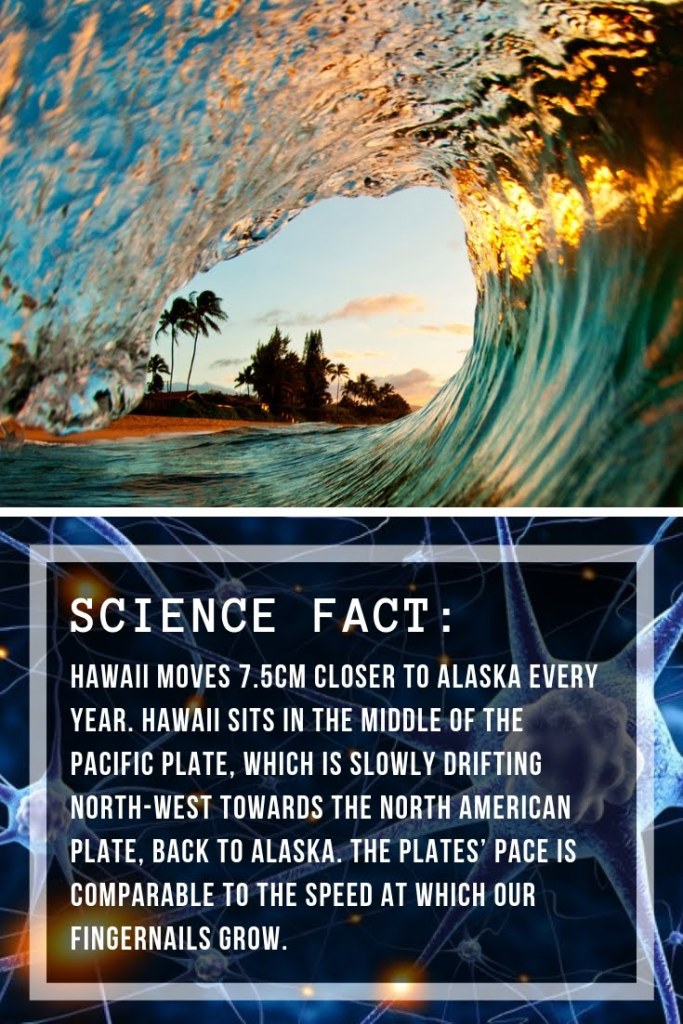
The Earth’s crust is split into gigantic pieces called tectonic plates. These plates are in constant motion, propelled by currents in the Earth’s upper mantle. Hot, less-dense rock rises before cooling and sinking, giving rise to circular convection currents which act like giant conveyor belts, slowly shifting the tectonic plates above them.
Hawaii sits in the middle of the Pacific Plate, which is slowly drifting north-west towards the North American Plate, back to Alaska. The plates’ pace is comparable to the speed at which our fingernails grow.
Thanks for Reading!
The Great Barrier Reef
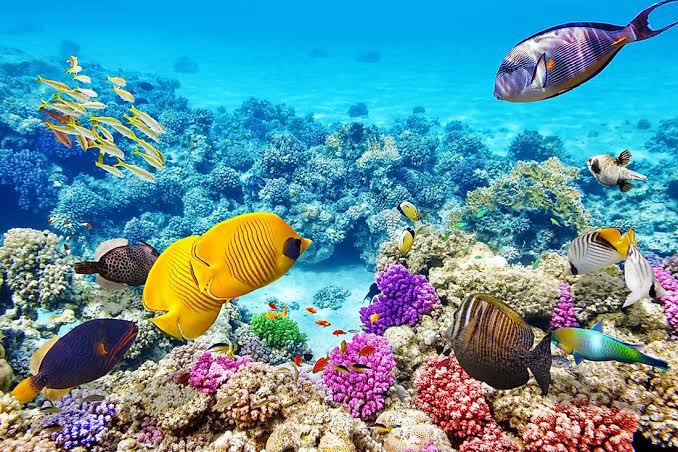
The Great Barrier Reef is the world’s largest coral reef system composed of over 2,900 individual reefs[3] and 900 islands stretching for over 2,300 kilometres (1,400 mi) over an area of approximately 344,400 square kilometres (133,000 sq mi). The reef is located in the Coral Sea, off the coast of Queensland, Australia, separated from the coast by a channel 100 miles wide in places and over 200 feet deep. The Great Barrier Reef can be seen from outer space and is the world’s biggest single structure made by living organisms. This reef structure is composed of and built by billions of tiny organisms, known as coral polyps.[8] It supports a wide diversity of life and was selected as a World Heritage Site in 1981. CNN labelled it one of the seven natural wonders of the world in 1997. Australian World Heritage places included it in its list in 2007. The Queensland National Trust named it a state icon of Queensland in 2006.
Great Barrier Reef
UNESCO World Heritage Site
GreatBarrierReef-EO.JPG
Satellite image of part of the Great Barrier Reef adjacent to the Queensland coastal areas of Airlie Beach and Mackay
Location
Off the east coast of the Queensland mainland, Australia
Criteria
Natural: vii, viii, ix, x
Reference
154
Inscription
1981 (5th Session)
Area
34,870,000 ha
Website
http://www.gbrmpa.gov.au
Coordinates
18°17′S 147°42′E
Great Barrier Reef is located in QueenslandGreat Barrier Reef
Centre of the Great Barrier Reef
Show map of Queensland
Show map of Australia
Show all
A large part of the reef is protected by the Great Barrier Reef Marine Park, which helps to limit the impact of human use, such as fishing and tourism. Other environmental pressures on the reef and its ecosystem include runoff, climate change accompanied by mass coral bleaching, dumping of dredging sludge and cyclic population outbreaks of the crown-of-thorns starfish. According to a study published in October 2012 by the Proceedings of the National Academy of Sciences, the reef has lost more than half its coral cover since 1985, a finding reaffirmed by a 2020 study which found over half of the reef’s coral cover to have been lost between 1995 and 2017, with the effects of a widespread 2020 bleaching event not yet quantified.
The Great Barrier Reef has long been known to and used by the Aboriginal Australian and Torres Strait Islander peoples, and is an important part of local groups’ cultures and spirituality. The reef is a very popular destination for tourists, especially in the Whitsunday Islands and Cairns regions. Tourism is an important economic activity for the region, generating over AUD$3 billion per year. In November 2014, Google launched Google Underwater Street View in 3D of the Great Barrier Reef.
A March 2016 report stated that coral bleaching was more widespread than previously thought, seriously affecting the northern parts of the reef as a result of warming ocean temperatures. In October 2016, Outside published an obituary for the reef; the article was criticized for being premature and hindering efforts to bolster the resilience of the reef. In March 2017, the journal Nature published a paper showing that huge sections of an 800-kilometre (500 mi) stretch in the northern part of the reef had died in the course of 2016 due to high water temperatures, an event that the authors put down to the effects of global climate change. The percentage of baby corals being born on the Great Barrier Reef dropped drastically in 2018 and scientists are describing it as the early stage of a “huge natural selection event unfolding”. Many of the mature breeding adults died in the bleaching events of 2016–17 leading to low coral birth rates. The types of corals that reproduced also changed, leading to a “long-term reorganisation of the reef ecosystem if the trend continues.”
The Great Barrier Reef Marine Park Act 1975 (section 54) demands every five years an Outlook Report on the Reef’s health, pressures, and future. The last report was published in 2019.
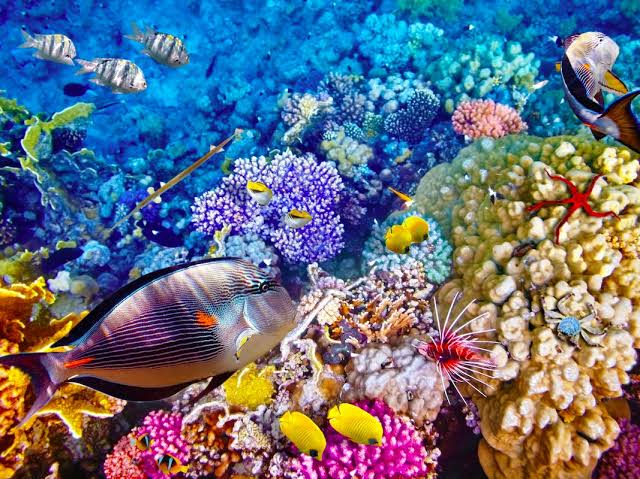
The Great Barrier Reef is a distinct feature of the East Australian Cordillera division. It reaches from Torres Strait (between Bramble Cay, its northernmost island, and the south coast of Papua New Guinea) in the north to the unnamed passage between Lady Elliot Island (its southernmost island) and Fraser Island in the south. Lady Elliot Island is located 1,915 km (1,190 mi) southeast of Bramble Cay as the crow flies. It includes the smaller Murray Islands.
The plate tectonic theory indicates Australia has moved northwards at a rate of 7 cm (2.8 in) per year, starting during the Cenozoic. Eastern Australia experienced a period of tectonic uplift, which moved the drainage divide in Queensland 400 km (250 mi) inland. Also during this time, Queensland experienced volcanic eruptions leading to central and shield volcanoes and basalt flows. Some of these became high islands. After the Coral Sea Basin formed, coral reefs began to grow in the Basin, but until about 25 million years ago, northern Queensland was still in temperate waters south of the tropics—too cool to support coral growth. The Great Barrier Reef’s development history is complex; after Queensland drifted into tropical waters, it was largely influenced by reef growth and decline as sea level changed.
The Great Barrier Reef is clearly visible from aircraft flying over it
Reefs can increase in diameter by 1 to 3 centimetres (0.39 to 1.18 in) per year, and grow vertically anywhere from 1 to 25 cm (0.39 to 9.84 in) per year; however, they grow only above a depth of 150 metres (490 ft) due to their need for sunlight, and cannot grow above sea level.[27] When Queensland edged into tropical waters 24 million years ago, some coral grew, but a sedimentation regime quickly developed with erosion of the Great Dividing Range; creating river deltas, oozes and turbidites, unsuitable conditions for coral growth. 10 million years ago, the sea level significantly lowered, which further enabled sedimentation. The reef’s substrate may have needed to build up from the sediment until its edge was too far away for suspended sediments to inhibit coral growth. In addition, approximately 400,000 years ago there was a particularly warm Interglacial period with higher sea levels and a 4 °C (7 °F) water temperature change.
Heron Island, a coral cay in the southern Great Barrier Reef
The land that formed the substrate of the current Great Barrier Reef was a coastal plain formed from the eroded sediments of the Great Dividing Range with some larger hills (most of which were themselves remnants of older reefs or, in rare cases, volcanoes. The Reef Research Centre, a Cooperative Research Centre, has found coral ‘skeleton’ deposits that date back half a million years. The Great Barrier Reef Marine Park Authority (GBRMPA) considers the earliest evidence of complete reef structures to have been 600,000 years ago.[30] According to the GBRMPA, the current, living reef structure is believed to have begun growing on the older platform about 20,000 years ago. The Australian Institute of Marine Science agrees, placing the beginning of the growth of the current reef at the time of the Last Glacial Maximum. At around that time, sea level was 120 metres (390 ft) lower than it is today.
Aerial view of Arlington Reef
From 20,000 years ago until 6,000 years ago, sea level rose steadily around the world. As it rose, the corals could then grow higher on the newly submerged maritime margins of the hills of the coastal plain. By around 13,000 years ago the sea level was only 60 metres (200 ft) lower than the present day, and corals began to surround the hills of the coastal plain, which were, by then, continental islands. As the sea level rose further still, most of the continental islands were submerged. The corals could then overgrow the submerged hills, to form the present cays and reefs. Sea level here has not risen significantly in the last 6,000 years. The CRC Reef Research Centre estimates the age of the present, living reef structure at 6,000 to 8,000 years old.[29] The shallow water reefs that can be seen in air-photographs and satellite images cover an area of 20,679 km2, most (about 80%) of which has grown on top of limestone platforms that are relics of past (Pleistocene) phases of reef growth.
The remains of an ancient barrier reef similar to the Great Barrier Reef can be found in The Kimberley, Western Australia.
The Great Barrier Reef World Heritage Area has been divided into 70 bioregions, of which 30 are reef bioregions. In the northern part of the Great Barrier Reef, ribbon reefs and deltaic reefs have formed; these structures are not found in the rest of the reef system. A previously undiscovered reef, 500 meters tall and 1.5 km wide at the base, was found in the northern area in 2020. There are no atolls in the system and reefs attached to the mainland are rare.
Fringing reefs are distributed widely, but are most common towards the southern part of the Great Barrier Reef, attached to high islands, for example, the Whitsunday Islands. Lagoonal reefs are found in the southern Great Barrier Reef, and further north, off the coast of Princess Charlotte Bay. Crescentic reefs are the most common shape of reef in the middle of the system, for example the reefs surrounding Lizard Island. Crescentic reefs are also found in the far north of the Great Barrier Reef Marine Park, and in the Swain Reefs (20–22 degrees south). Planar reefs are found in the northern and southern parts, near Cape York Peninsula, Princess Charlotte Bay, and Cairns. Most of the islands on the reef are found on planar reefs: 158–160
Wonky holes can have localised impact on the reef, providing upwellings of fresh water, sometimes rich in nutrients contributing to eutrophication.
10 Science Facts That will Blow your mind!
1. There is enough DNA in the average person’s body to stretch from the sun to Pluto and back — 17 times
DNA length:
The human genome (the genetic code in each human cell) contains 23 DNA molecules (called chromosomes), each containing from 500,000 to 2.5 million nucleotide pairs. DNA molecules of this size are 1.7 to 8.5 cm long when uncoiled — about 5 cm on average. There are about 37 trillion cells in the human body, so if you were to uncoil all of the DNA encased in each cell and place the molecules end to end, it would sum to a total length of 2×10¹⁴ meters — enough for 17 Pluto round-trips (the distance from the sun to Pluto and then back again is 1.2×10¹³ meters). As an added bonus, you should know that we each share 99% of our DNA with every other human — just to show that we’re far more alike than different.
It takes a photon up to 40,000 years to travel from the core of the sun to its surface, but only 8 minutes to travel the rest of the way to Earth
A photon travels, on average, a particular distance before being briefly absorbed and released by an atom, which scatters it in a new random direction. To travel from the sun’s core to the sun’s surface (696,000 kilometers) so it can escape into space, a photon needs to make a huge number of drunken jumps.
The calculation is a little tricky, but the conclusion is that a photon takes many thousands and many millions of years to drunkenly wander to the surface of the Sun. In a way, some of the light that reaches us today is energy produced millions of years ago. Amazing!
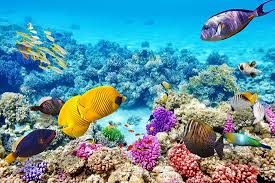
2. At over 2,000 kilometers long, The Great Barrier Reef is the largest living structure on Earth
Coral reefs consist of huge numbers of individual coral polyps (soft-bodied, invertebrate animals) that are linked together by tissue. The Great Barrier Reef is an interlinked system of about 3,000 reefs and 900 coral islands divided by narrow passages, located just beneath the surface of the Coral Sea. Spanning more than 2,000 km and covering an area of some 350,000 sq km, it is the largest living structure on Earth and the only one visible from space. However, this fragile coral colony is beginning to crumble, battered by the effects of climate change, pollution, and manmade disasters.
3. There are 8 times as many atoms in a teaspoonful of water as there are teaspoonfuls of water in the Atlantic ocean
A teaspoon of water (about 5 mL) contains 2×10²³ water molecules, but each water molecule is comprised of 3 atoms: two hydrogen atoms and one of oxygen. Moreover, if you’d laid down end to end each water molecule from a teaspoon down end to end, you’d end up with a length of 50 billion km — 10 times the width of our solar system.
4. In an entire lifetime, the average person walks the equivalent of five times around the world
The average moderately active person takes around 7,500 step/day. If you maintain that daily average and live until 80 years of age, you’ll have walked about 216,262,500 steps in your lifetime. Doing the math; the average person with the average stride living until 80 will walk a distance of around 110,000 miles — which is the equivalent of walking about 5 times around the Earth, right on the equator.
5. There are actually over two dozen states of matter (that we know of)
Everybody knows that there at least three states of matter: solid, liquid, and gas. If you’re a little bit more versed in physics, you also know about the fourth fundamental state of matter called plasma — a hot ionized gas, with prime examples including lightning or neon signs. But beyond these common states of matter, scientists have discovered a myriad of exotic states of matter that occur under special conditions. One of them is the Bose-Einstein condensate, where atoms chilled to only 0.000001 degrees above absolute zero start behaving like waves, rather than particles as they ought to on the macroscopic scale. Essentially, the atoms behave like one super atom, acting in unison.
Another interesting exotic state of matter is represented by time crystals — regular, boringly ordered crystals with a twist: A fourth dimension, time, is added so that the material exhibits different periodic structures over time. What makes these crystals particularly remarkable has less to do with the fact that they repeat in time but rather more with the fact that they’re intrinsically out of equilibrium. Because time crystals are never able to settle down, say into a diamond or ruby, there’s a lot we can learn from them.
6. Killer whales are actually dolphins
Despite their name, killer whales or orcas are the largest members of the dolphin family. Technically, orcas are also whales because delphinids belong to the Cetacean order within the toothed whale (Odontoceti) suborder. However, the term whale is typically reserved for baleen whales of the Mysticeti suborder.
The major physical feature that ensures orcas are dolphins is the presence of a melon — a fatty deposit that assists the animals in echolocation and only exists in dolphins.
Orcas are highly intelligent, highly adaptable and able to communicate and coordinate hunting tactics. They are extremely fast swimmers and have been recorded at speeds of up to 54kph! A wild orca pod can cover over 160 kilometers a day, foraging, and socializing.
7. Grasshoppers have ears in their bellies
Unlike humans, grasshoppers do not have ears on the side of their heads. Like the ears of people, the grasshopper sound detector is a thin membrane called a tympanum, or “eardrum”. In adults, the tympanum is covered and protected by the wings, and allows the grasshopper to hear the songs of its fellow grasshoppers.
The grasshopper tympanum is adapted to vibrate in response to signals that are important to the grasshopper. Male grasshoppers use sounds to call for mates and to claim territory. Females can hear the sound that males make and judge the relative size of the male from the pitch of the call (large males make deeper sounds). Other males can hear the sounds and judge the size of a potential rival. Males use this information to avoid fights with larger male grasshoppers or to chase smaller rivals from their territory.
8. You can’t taste food without saliva
In order for food to have taste, chemicals from the food must first dissolve in saliva. It’s only once they’ve been dissolved in a liquid that the chemicals can be detected by receptors on taste buds. During this process, some salivary constituents chemically interact with taste substances. For example, salivary buffers (e.g., bicarbonate ions) decrease the concentration of free hydrogen ions (sour taste), and there are some salivary proteins that may bind with bitter taste substances.
Here’s a quick science experiment to test this out — get out a clean towel, and rub your tongue dry; then place some dry foods on your tongue, one by one, such as a cookie, pretzel, or some other dry food. After this session, drink a glass of water and repeat. Did you feel a difference?
9. When Helium is cooled to almost absolute zero (-460°F or -273°C, the lowest temperature possible), it becomes a liquid with surprising properties: it flows against gravity and will start running up and over the lip of a glass container!
superfluid helium.
We all know helium as a gas for blowing up balloons and making people talk like chipmunks, but what most people don’t know is that it comes in two distinct liquid states — one of which is borderline creepy. When helium is just a few degrees below its boiling point of –452°F (–269°C), it can suddenly do things that other fluids can’t, like dribble through molecule-thin cracks, climb up and over the sides of a dish, and remain motionless when its container is spun. No longer a mere liquid, the helium has become a superfluid — a liquid that flows without friction.
“If you set [down] a cup with a liquid circulating around and you come back 10 minutes later, of course, it’s stopped moving,” says John Beamish, an experimental physicist at the University of Alberta in Edmonton.
This happens because atoms in the liquid will collide with one another and slow down.
“But if you did that with helium at low temperature and came back a million years later,” he says, “it would still be moving”.
10. If Betelgeuse exploded, transitioning from the red supergiant stage to supernova, it would light our sky continuously for two months. It could happen anytime — within a couple of thousand years, tomorrow or even now supernova explosion.
 Science Facts