1. There is enough DNA in the average person’s body to stretch from the sun to Pluto and back — 17 times
DNA length:
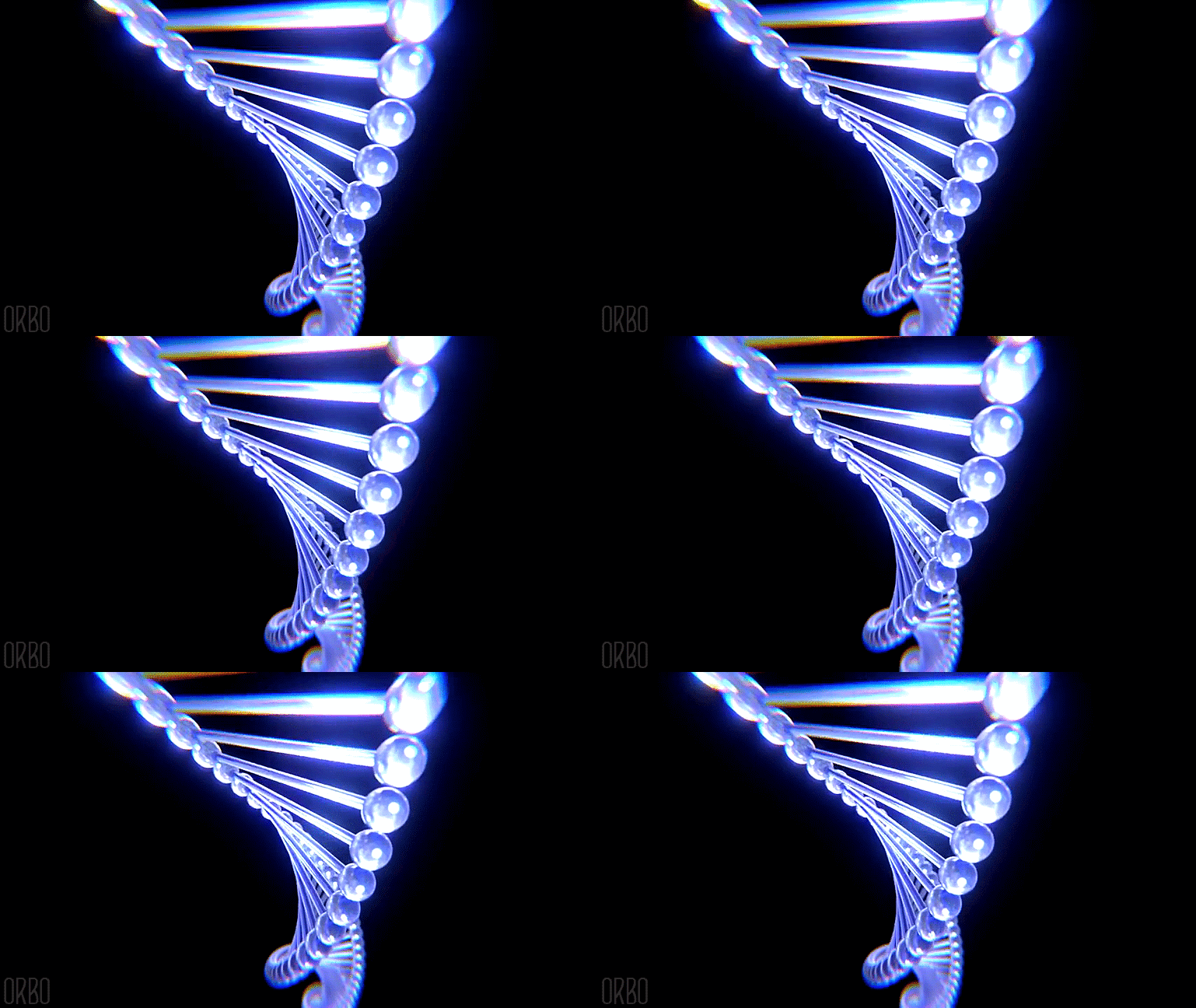
The human genome (the genetic code in each human cell) contains 23 DNA molecules (called chromosomes), each containing from 500,000 to 2.5 million nucleotide pairs. DNA molecules of this size are 1.7 to 8.5 cm long when uncoiled — about 5 cm on average. There are about 37 trillion cells in the human body, so if you were to uncoil all of the DNA encased in each cell and place the molecules end to end, it would sum to a total length of 2×10¹⁴ meters — enough for 17 Pluto round-trips (the distance from the sun to Pluto and then back again is 1.2×10¹³ meters). As an added bonus, you should know that we each share 99% of our DNA with every other human — just to show that we’re far more alike than different.
It takes a photon up to 40,000 years to travel from the core of the sun to its surface, but only 8 minutes to travel the rest of the way to Earth
A photon travels, on average, a particular distance before being briefly absorbed and released by an atom, which scatters it in a new random direction. To travel from the sun’s core to the sun’s surface (696,000 kilometers) so it can escape into space, a photon needs to make a huge number of drunken jumps.
The calculation is a little tricky, but the conclusion is that a photon takes many thousands and many millions of years to drunkenly wander to the surface of the Sun. In a way, some of the light that reaches us today is energy produced millions of years ago. Amazing!
2. At over 2,000 kilometers long, The Great Barrier Reef is the largest living structure on Earth
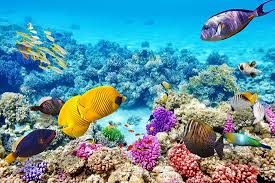
Coral reefs consist of huge numbers of individual coral polyps (soft-bodied, invertebrate animals) that are linked together by tissue. The Great Barrier Reef is an interlinked system of about 3,000 reefs and 900 coral islands divided by narrow passages, located just beneath the surface of the Coral Sea. Spanning more than 2,000 km and covering an area of some 350,000 sq km, it is the largest living structure on Earth and the only one visible from space. However, this fragile coral colony is beginning to crumble, battered by the effects of climate change, pollution, and manmade disasters.
3. There are 8 times as many atoms in a teaspoonful of water as there are teaspoonfuls of water in the Atlantic ocean
A teaspoon of water (about 5 mL) contains 2×10²³ water molecules, but each water molecule is comprised of 3 atoms: two hydrogen atoms and one of oxygen. Moreover, if you’d laid down end to end each water molecule from a teaspoon down end to end, you’d end up with a length of 50 billion km — 10 times the width of our solar system.
4. In an entire lifetime, the average person walks the equivalent of five times around the world
The average moderately active person takes around 7,500 step/day. If you maintain that daily average and live until 80 years of age, you’ll have walked about 216,262,500 steps in your lifetime. Doing the math; the average person with the average stride living until 80 will walk a distance of around 110,000 miles — which is the equivalent of walking about 5 times around the Earth, right on the equator.
5. There are actually over two dozen states of matter (that we know of)
Everybody knows that there at least three states of matter: solid, liquid, and gas. If you’re a little bit more versed in physics, you also know about the fourth fundamental state of matter called plasma — a hot ionized gas, with prime examples including lightning or neon signs. But beyond these common states of matter, scientists have discovered a myriad of exotic states of matter that occur under special conditions. One of them is the Bose-Einstein condensate, where atoms chilled to only 0.000001 degrees above absolute zero start behaving like waves, rather than particles as they ought to on the macroscopic scale. Essentially, the atoms behave like one super atom, acting in unison.
Another interesting exotic state of matter is represented by time crystals — regular, boringly ordered crystals with a twist: A fourth dimension, time, is added so that the material exhibits different periodic structures over time. What makes these crystals particularly remarkable has less to do with the fact that they repeat in time but rather more with the fact that they’re intrinsically out of equilibrium. Because time crystals are never able to settle down, say into a diamond or ruby, there’s a lot we can learn from them.
6. Killer whales are actually dolphins
Despite their name, killer whales or orcas are the largest members of the dolphin family. Technically, orcas are also whales because delphinids belong to the Cetacean order within the toothed whale (Odontoceti) suborder. However, the term whale is typically reserved for baleen whales of the Mysticeti suborder.
The major physical feature that ensures orcas are dolphins is the presence of a melon — a fatty deposit that assists the animals in echolocation and only exists in dolphins.
Orcas are highly intelligent, highly adaptable and able to communicate and coordinate hunting tactics. They are extremely fast swimmers and have been recorded at speeds of up to 54kph! A wild orca pod can cover over 160 kilometers a day, foraging, and socializing.
7. Grasshoppers have ears in their bellies
Unlike humans, grasshoppers do not have ears on the side of their heads. Like the ears of people, the grasshopper sound detector is a thin membrane called a tympanum, or “eardrum”. In adults, the tympanum is covered and protected by the wings, and allows the grasshopper to hear the songs of its fellow grasshoppers.
The grasshopper tympanum is adapted to vibrate in response to signals that are important to the grasshopper. Male grasshoppers use sounds to call for mates and to claim territory. Females can hear the sound that males make and judge the relative size of the male from the pitch of the call (large males make deeper sounds). Other males can hear the sounds and judge the size of a potential rival. Males use this information to avoid fights with larger male grasshoppers or to chase smaller rivals from their territory.
8. You can’t taste food without saliva
In order for food to have taste, chemicals from the food must first dissolve in saliva. It’s only once they’ve been dissolved in a liquid that the chemicals can be detected by receptors on taste buds. During this process, some salivary constituents chemically interact with taste substances. For example, salivary buffers (e.g., bicarbonate ions) decrease the concentration of free hydrogen ions (sour taste), and there are some salivary proteins that may bind with bitter taste substances.
Here’s a quick science experiment to test this out — get out a clean towel, and rub your tongue dry; then place some dry foods on your tongue, one by one, such as a cookie, pretzel, or some other dry food. After this session, drink a glass of water and repeat. Did you feel a difference?
9. When Helium is cooled to almost absolute zero (-460°F or -273°C, the lowest temperature possible), it becomes a liquid with surprising properties: it flows against gravity and will start running up and over the lip of a glass container!
superfluid helium.
We all know helium as a gas for blowing up balloons and making people talk like chipmunks, but what most people don’t know is that it comes in two distinct liquid states — one of which is borderline creepy. When helium is just a few degrees below its boiling point of –452°F (–269°C), it can suddenly do things that other fluids can’t, like dribble through molecule-thin cracks, climb up and over the sides of a dish, and remain motionless when its container is spun. No longer a mere liquid, the helium has become a superfluid — a liquid that flows without friction.
“If you set [down] a cup with a liquid circulating around and you come back 10 minutes later, of course, it’s stopped moving,” says John Beamish, an experimental physicist at the University of Alberta in Edmonton.
This happens because atoms in the liquid will collide with one another and slow down.
“But if you did that with helium at low temperature and came back a million years later,” he says, “it would still be moving”.
10. If Betelgeuse exploded, transitioning from the red supergiant stage to supernova, it would light our sky continuously for two months. It could happen anytime — within a couple of thousand years, tomorrow or even now supernova explosion.


